Teon - Morte em Tupi-Guarani.
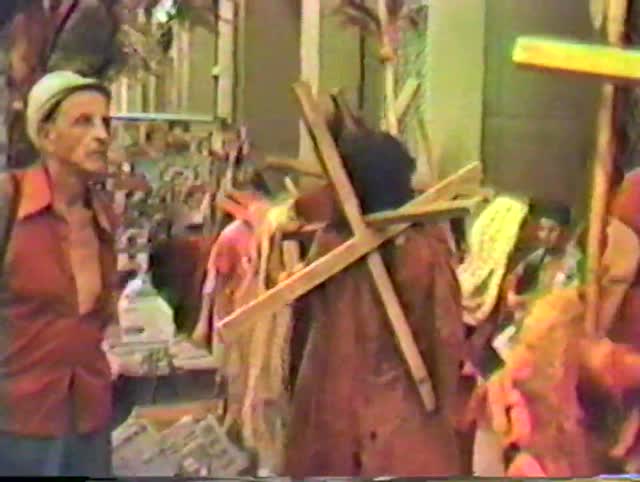
Teon is a ritual, a prayer for the millions of indigenous people who have been killed all across the Americas. The communal life, the religiosity, the contact with the white man, disease, slavery, and the genocide of indigenous culture are shown in a sequence of eight tableaus. A procession walks by slowly, following the rhythm of a drum. The performance begins with a ritual preparation. In a circle, the indigenous people share bread and water, they sing and dance with war cries. The ceremony is interrupted by the arrival of an indigenous person in chains. The group releases him, but he falls at the feet of his companions. The tribe lets out a cry of pain, and with their bodies they form a totem. The sound of a bomb exploding is heard. The totems fall apart, the indigenous people are dead. In the middle of the circle, a single indigenous woman survives, yet three people come from the audience and surround the dead bodies with chains. The destruction is complete. The old indigenous woman sets her own body on fire. Combining masks, costumes, and choreography, the performers become live sculptures involving the audience as in a dream.
Based in Porto Alegre, The Tribo de Atuadores Ói Nóis Aqui Traveiz was born in 1978 out of a desire for a radical renovation of the language of theatre. During the several years of their existence, they have created a personal aesthetics founded upon the authorial work of the actor, both on the stage and on the streets. Their venue, the Terreira da Tribo de Atuadores Ói Nóis Aqui Traveiz, works as a community theatre school, offering several free workshops open to the public. Their tribal organization is based on the principle of collective work, both in the creative process and in the maintenance of the space. For Ói Nóis Aqui Traveiz, theater is an instrument for both revealing and analyzing reality, and it's function is social - to contribute to the collective knowledge and to the improvement of the quality of life of the people. In a world marked by exclusion, marginalization, homogenization, by dehumanizing and barbaric efforts, they see it as their moral imperative to denounce injustice, sold opinions, authoritarianism, mediocrity and the erasing of memory. Ói Nóis sees theatre as an art of resistance, in the service of arts and politics, an art that does not fit the market patterns for ethics and aesthetics. Instead, they see theater as a way of life and as a vehicle for ideas: a theater that does not comment on life, but that takes part in it.