Kinesthetic Empathies & the Politics of Compassion.
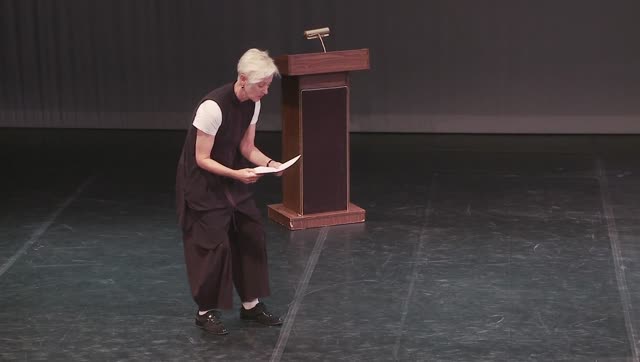
In the performative lecture "Kinesthetic Empathies & the Politics of Compassion" (2011), Susan Leigh Foster poses questions of witnessing, empathizing, and knowing as corporeal potentialities. From the outer limits of the possible Foster introduces various theories on empathy-in one example from Monsieur Chevalier Louis de Jaucourt, she explores the viewer's ability to relate to the tightrope walker, whose precarious balancing act leaves both viewer and dancer in suspense, the viewer feeling as though they too might fall. In another instance she draws from philosophers Adam Smith and, later, John Martin to illustrate the impossibility of truly feeling what another experiences, although dance's ability to ignite "inner mimicry" creates a resonance between the dancing and the viewing bodies. All the while Foster dances, gestures, and emphasizes those moments of semiosis between dancer and viewer, simultaneously rejecting the problematics of a dance politic favoring sameness over difference and one favoring difference to the exclusion of commonalities. She points to sociocultural factors informing each kinesthetic framework and to historic and contemporary efforts to justify the "workings of power" through empathetic responses that actually limit the means of true societal transformation. Toward the end of the lecture Foster invites volunteers to mirror one another in pursuit of differences and parallels. As the volunteers dance Foster champions the empathetic frameworks as tools for sensing "how power moves, when it consolidates, and where it disperses." The lecture is followed by a Question and Answer discussion.
Susan Leigh Foster, choreographer and scholar, is Distinguished Professor in the Department of World Arts and Cultures/Dance at UCLA. She is the author of Reading Dancing: Bodies and Subjects in Contemporary American Dance, Choreography and Narrative: Ballet's Staging of Story and Desire, Dances that Describe Themselves: The Improvised Choreography of Richard Bull, and Choreographing Empathy: Kinesthesia in Performance. She is also the editor of three anthologies: Choreographing History, Corporealities, and Worlding Dance. Three of her danced lectures can be found at the Pew Center for Arts and Heritage website.