A morte e a donzela.
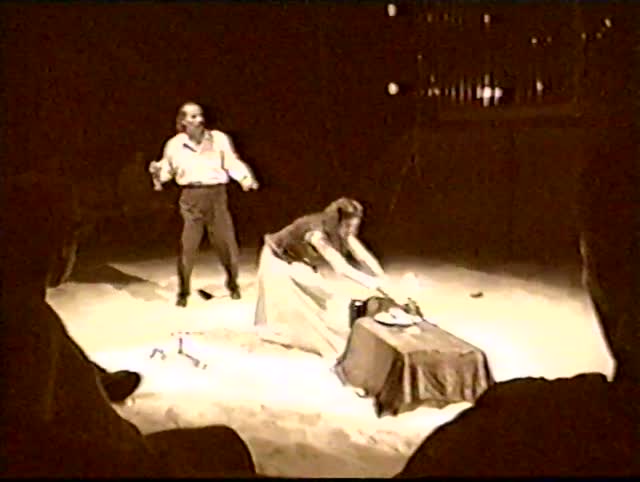
Dorfman's play addresses the institutionalized violence of the military dictatorships which used torture as a tool for control and coercion, deeply marking the people of Latin America and their history. The play features three characters connected by political repression and torture: a husband, a wife who has been tortured, and an alleged torturer. Ói Nóis Aqui Traveiz's staging continues their research into the teatro de vivência, and demonstrates the anguish experienced by Brazilians, Chileans, and all Latin Americans who lived through the late twentieth century, with the end of the military regimes: How can repressors and repressed live on the same earth, share a same table? How to heal a country traumatized by fear? The play explores not only the themes of torture, justice, fear, and healing, it also raises a series of questions: How to tell the truth if the mask we wear is identical to our face? How can we tell if our memory is saving or deceiving us? How to keep our innocence in an evil and corrupt world? Can we forgive those who have perpetrated terrible damage upon us?
Based in Porto Alegre, The Tribo de Atuadores Ói Nóis Aqui Traveiz was born in 1978 out of a desire for a radical renovation of the language of theatre. During the several years of their existence, they have created a personal aesthetics founded upon the authorial work of the actor, both on the stage and on the streets. Their venue, the Terreira da Tribo de Atuadores Ói Nóis Aqui Traveiz, works as a community theatre school, offering several free workshops open to the public. Their tribal organization is based on the principle of collective work, both in the creative process and in the maintenance of the space. For Ói Nóis Aqui Traveiz, theater is an instrument for both revealing and analyzing reality, and it's function is social - to contribute to the collective knowledge and to the improvement of the quality of life of the people. In a world marked by exclusion, marginalization, homogenization, by dehumanizing and barbaric efforts, they see it as their moral imperative to denounce injustice, sold opinions, authoritarianism, mediocrity and the erasing of memory. Ói Nóis sees theatre as an art of resistance, in the service of arts and politics, an art that does not fit the market patterns for ethics and aesthetics. Instead, they see theater as a way of life and as a vehicle for ideas: a theater that does not comment on life, but that takes part in it.