Marta Minujín : Argentine conceptual artist
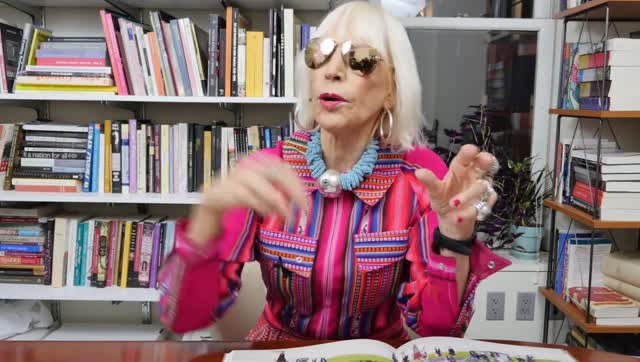
Marcial Godoy-Anativia interviewed Marta Minujín when she came to NYU to speak in the event series "Latin America's 1968," hosted by the Center for Latin American and Caribbean Studies (CLACS). In the interview, Minujín clarifies her philosophy of "happenings" and how they differ from performance art. Part and parcel of this, she also explains how her art is ephemeral, responding to the exigencies of place and time, which allows her to address social phenomena such as censorship and migration and to produce pieces that resist the commodification of the art object. They discuss Minujin's installation "La Menesunda," her "kidnappening" at the MOMA in NYC, and her "Parthenon of Books" at Documenta in Kassel, among other works.
Marta Minujín is an internationally acclaimed Argentine performance and conceptual artist whose career has helped define the role of participation, performance, and media in contemporary visual art. Minujín created her first "ephemeral" works in the 1960s in Paris and New York, where she and became an innovator of pop art, happenings, soft sculpture, and early video. Her celebrated La Menesunda (1965) created a sequence of 16 multi-sensory "situations" or environments for spectators to traverse; these included a beauty parlor, a couple in bed, and a shower of a confetti in an octagonal mirror chamber. Her 1967 Minuphone created an interactive "psychedelic" telephone booth in which voice triggered sensory changes in light, image, and sound. In May 1968--at the height of the cultural and political ferment of global 1968--Minujín hosted a series of soirèes/happenings with luminaries of fashion, art, finance, and politics at Manhattan's Center for Inter-American Relations (now Americas Society); the documentation became the basis of an immersive film installation, known as Minucode, which advanced a subtle critique of the role of "cultural" diplomacy needed to carry out the US cold war in Latin America. While in New York she participated in activities at Andy Warhol's Factory, and in the 1980s, created a performance in which she offered Warhol a corn on the cob as a way of paying off Argentina's foreign debt. She is perhaps best known for the 1983 piece The Parthenon of Books, a large-scale replica of a Greek parthenon built on Buenos Aires's main avenue, comprised of 30,000 books banned by the military regime during Argentina's "Dirty War," including works by Marx, Freud, and Foucault. Spectators were then invited to dismantle work. She has continued to create works that combine ephemeral materials with monumental scale, including Tower of Babel (2011), Agora of Peace (2013), and Hopscotch Art (2014). She lives and works in Buenos Aires