The temple of confessions : pre-performance street intervention, Detroit.
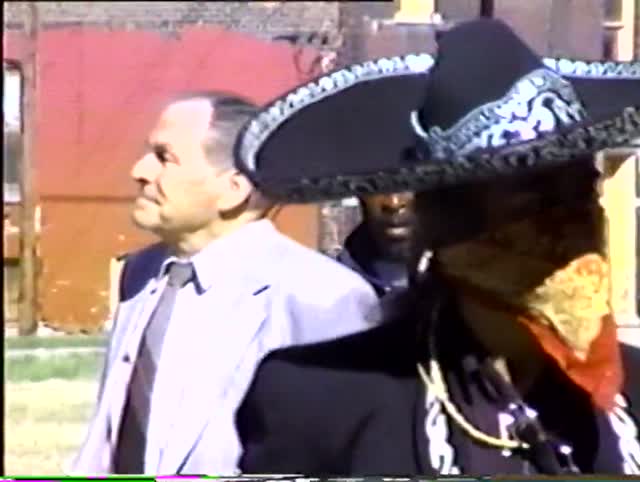
As a pre-performance strategy for advertising their upcoming 'The Temple of Confessions' performance/installation, La Pocha Nostra conducts a series of interventions in Detroit's public sphere. Two 'end-of-the-century saints', in search of sanctuary across the United States while gathering confessions on intercultural fears and desires, take on key politically relevant or visually interesting public sites. 'El Pre-Columbian Vato' or 'holy gang member' (performed by Roberto Sifuentes) and 'San Pocho Aztlaneca' (a 'hyper-exoticied curio shop shaman for spiritual tourists' performed by Guillermo Gómez-Peña) are walked in leashes by 'corporate dominatrix' Michelle Ceballos and tended by 'chola/nun' Norma Medina; in this fashion, they visit an array of public places, from a financial/downtown district fancy café, to the US-Canada border, always followed by an entourage of photographers and videographers from the local media that document their 'pilgrimage'. Through these performative irruptions in everyday life, La Pocha Nostra creates the means for provoking in the "Temple" prospective audience an aura of expectation, a bearing witness of a mythology of intercultural fears and desires; this, in turn, would broaden the diversity of the audience, and create a propitious environment for their upcoming 'confessions'. La Pocha Nostra (www.pochanostra.com) is an ever-morphing trans-disciplinary arts organization, founded in 1993 by Guillermo Gómez-Peña, Roberto Sifuentes, and Nola Mariano in California. The objective was to formally conceptualize Gómez-Peña's collaborations with other performance artists. It provides a base (and forum) for a loose network of rebel artists from various disciplines, generations and ethnic backgrounds, whose common denominator is the desire to cross and erase dangerous borders between art and politics, practice and theory, artist and spectator. As of June 2006, members include performance artists Guillermo Gómez-Peña, Violeta Luna, Michelle Ceballos, and Roberto Sifuentes; curators Gabriela Salgado and Orlando Britto; and over thirty associates worldwide in countries such as Mexico, Spain, the UK, and Australia. Projects range from performance solos and duets to large-scale performance installations including video, photography, audio, and cyber-art. La Pocha collaborates across national borders, race, gender and generations. Their collaborative model functions both as an act of citizen diplomacy and as a means to create ephemeral communities of like-minded rebels. The basic premise of these collaborations is founded on an ideal: If we learn to cross borders on stage, we may learn how to do so in larger social spheres. La Pocha strives to eradicate myths of purity and dissolve borders surrounding culture, ethnicity, gender, language, and métier. These are radical acts. Hemispheric Institute of Performance and Politics