Acción 2
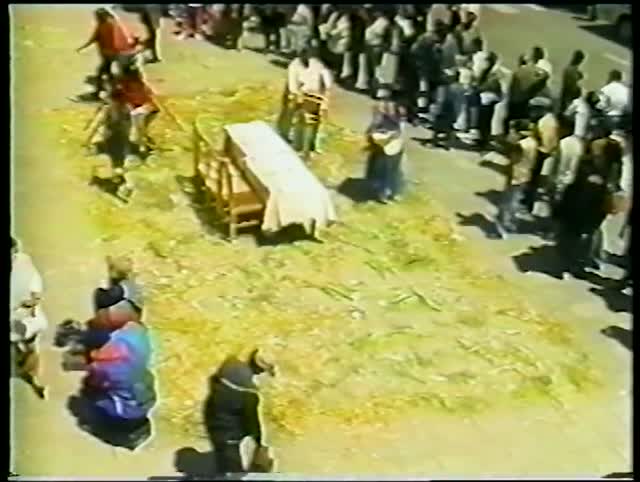
This is a video documentation of an 'acción' performed in a public square in La Paz, Bolivia. Mujeres Creando's proposal considers that 'the street is the space where we make sense, where be become full of meaning;' thus, the streets are the most important stage to perform political gestures and to enact political actions. Through the simple but powerful act of setting a dining table in the middle of the streets, Mujeres Creando bring together the private and the public, and reconfigure the structures of power that constrain people's freedom. The acción of sharing food with the passers-by not only addresses the fact that we all are equals and part of the same society, but also invites to remember that sharing communal activities is an act of love.
Mujeres Creando is a feminist anarchist movement created in 1990 in La Paz, Bolivia. It is comprised of women of different cultural, social, and ethnic origins, and explores creativity as an instrument of resistance and social participation. The three women who founded this communitarian proposal (Maria Galindo, Julieta Paredes, and Monica Mendoza) worked together to recover the public space that the patriarchal system appropriated. In this sense, the group does not only struggle for women's rights or issues that affect women, but also against other problems that affect society. The ways of expression of Mujeres Creando are graffiti, creativity, ongoing public debates, and acciones, along with a constant presence in the streets to reclaim a voice and participation in the public sphere. Since its beginnings, the group has been part of international gatherings, dialoguing with different feminist tendencies and thus being able to build its ideological identity within the autonomous feminism, in contrast and in connection with global struggles. In April 2001, due to ethical and political disagreements, there was a division in the group, which brought the necessity to differentiate names. In spite of this divergence, Maria Galindo continues working with Mujeres Creando in Bolivia.