Arrastrando un cuerpo
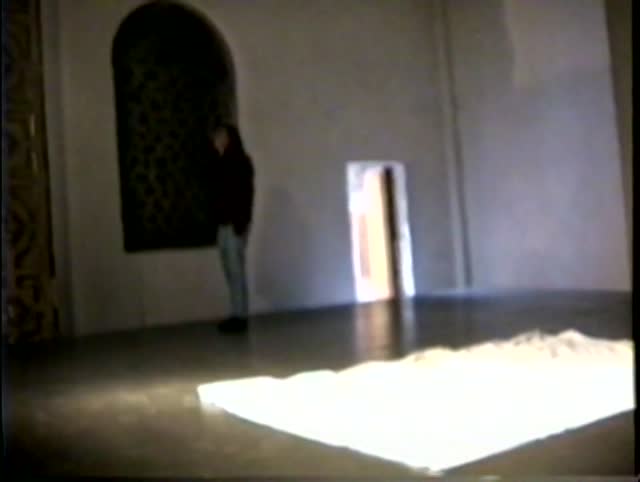
In Arrastrando un cuerpo (1995), Elvira Santamaría drags the naked body of Eugenia Vargas, covered in a large white cloth through the Zócalo Plaza in México City. As the multitude gathers to see what is happening, the line between art and tragedy blurs. "Is that a theatre show?... No, it is a dead person. They killed him." These statements are overheard as the performers slowly advance. Eventually, some construction workers help Elvira in her task, confusing the body for a "fallen partner," a person who dies in a work accident and has to be buried in an illegal manner, as the construction workers' employers often don't provide insurance. They help her in moving Eugenia to "the heart of Mexico" in Elvira's words, which, in their interpretation, is the mast of the flagpole. At last, Elvira tells the confused onlookers a story of her childhood, about the fear of the Holocaust and the chance of a similar tragedy happening in Mexico. Finally, Ex-Teresa organizers invite viewers to join them in the conversation to be held at their art space, with people following along in the aftermath of the chaotic event. The everlasting presence of violence in the collective mind of Mexican citizens is central to this performance, where solidarity and shared histories of state violence are explored Hemispheric Institute
El Museo Ex Teresa Arte Actual is an artistic space located in the Centro Histórico neighborhood of Mexico City. Opened in 1993, Ex Teresa was named for its location in what was formerly the temple of Santa Teresa la Antigua. For more than 25 years, the museum and cultural space has dedicated itself to the promotion and creation of contemporary art, as well as exhibitions and research into creative processes around the creation of performance, sound, and video art, among other modalities Hemispheric Institute